

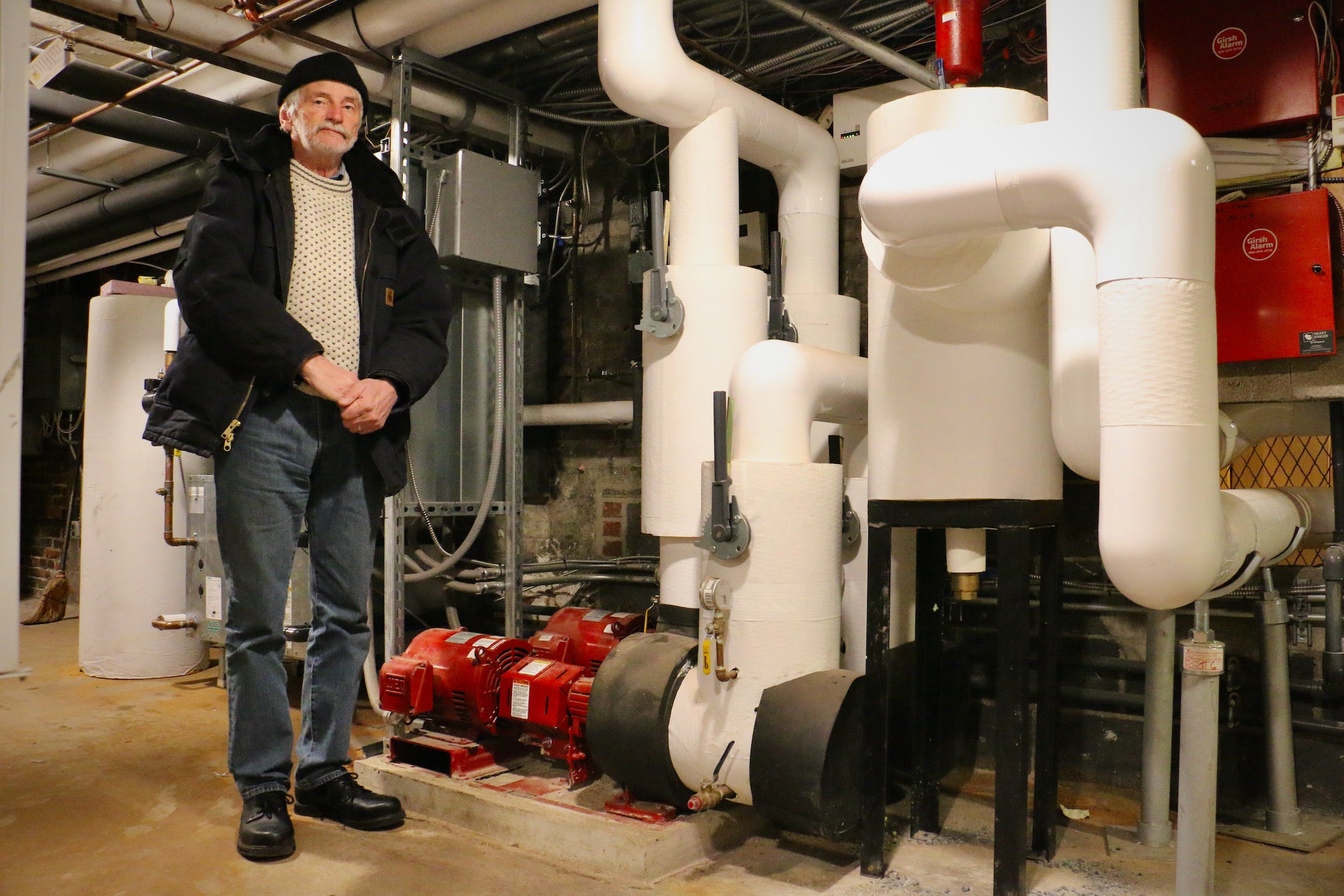
The most expensive part of a geothermal installation is the drill rig because the holes need to go deep enough in the ground to reach the bedrock.
In the case of the German Society of Pennsylvania, that was about 400 feet through the Wissahickon schist, until the drill hit granite. The temperature in that part of the earth is a consistent 55 degrees Fahrenheit — think of it like a 55-degree storage facility. Boreholes in vertical loops are lined with high-density polyethylene pipes and filled with water.
“There are two circulation pumps that are circulating the water through all these loops up, down, up, down, up, 23 times,” said Michels.
The water flowing through those vertical looped pipes will be in the ground long enough to reach that steady temperature of about 55 degrees.
While it may be 100 degrees on the surface, that bedrock temperature will remain 55 degrees.
From beneath the parking lot, that 55-degree water flows into the basement to a heat pump in the society’s former vault. The water is used to heat the building in winter — or cool it in the summer.
It’s similar to the way a refrigerator works.
Check out the back of your refrigerator — it’s hot. That’s because it removes the heat from the inside and dumps it into your kitchen. In the winter, your refrigerator doesn’t have to work very hard. When it’s summertime and 90 degrees, your refrigerator works really, really hard.
However, a heat pump operating with 55-degree water running through it no matter the season doesn’t have to work hard in summer or winter. That’s a very happy heat pump that uses very little electricity. And there’s no need for carbon-polluting natural gas to heat the home. The heat pump also does something natural gas can’t. It provides air conditioning as well.
Michels said the whole thing cost about $1.4 million to install at the German Society — but they were going to spend that much anyway to put in a new heating and cooling system to preserve their rare book collection. And their gas bill went down from $1,200 a month to just $63 a month, which covers cooking gas.
Michels said his goal is to convince the National Park Service to install a similar system across the street at the Edgar Allen Poe National Historic Site. He also envisions a networked system that heats and cools the Spring Garden Apartments, located behind the Society’s building and run by the Philadelphia Housing Authority.
Post a Comment